

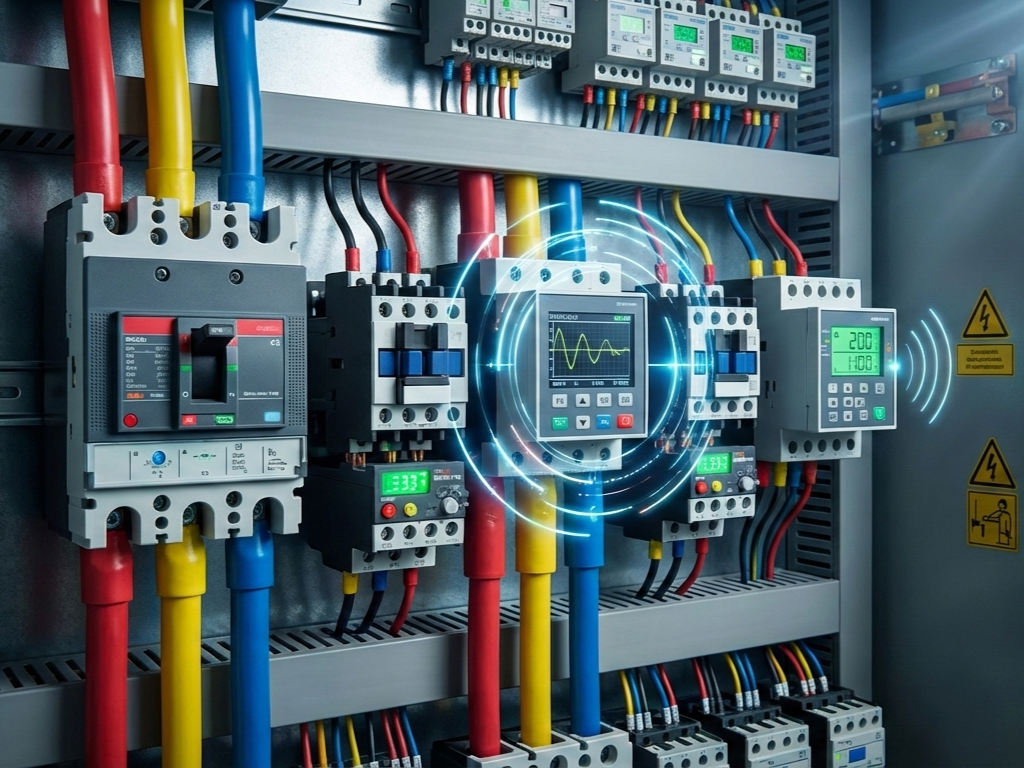
3-Phase Motor Protection in LV Panels: How to Choose MCCB, Contactor, Overload Relay, and VFD (Practical Guide)
Reliable motor protection is not complicated: start with the motor nameplate current (FLA), then size the breaker (MCB/MCCB) so it tolerates starting inrush, choose a motor-duty contactor, set the thermal overload relay close to the nameplate current, and—if you use a VFD—enter motor data and tune acceleration/deceleration and overload limits. Done right, you reduce nuisance trips, extend motor life, and cut downtime.
Why Motor Protection Is a Major Downtime Driver
In industrial environments, motors run fans, pumps, conveyors, mixers, and more. Many “motor problems” are actually panel problems: undersized breakers trip during start, incorrect contactor duty causes overheating, overload relay settings are too high (no real protection) or too low (false trips), and VFDs are installed without proper motor parameters—leading to poor torque and higher current.
Step 1 — Read the Motor Nameplate (Don’t Start From Catalogs)
Capture these minimum details before selecting any protection device:
- Power (kW / HP)
- Voltage (commonly 380–400 V, 3-phase)
- Full Load Current (FLA) in amps (A) — the most important number
- Frequency (50 Hz)
- Power factor (PF) and efficiency (if shown)
- Starting method: DOL, star-delta, soft starter, or VFD
Tip: If the nameplate shows current (A), use that as your main reference.
Step 2 — Quick Current Estimate (If the Nameplate Is Unreadable)
For a 3-phase motor, you can estimate current using: I ≈ P / (√3 × V × η × PF) (where η is efficiency and PF is power factor).
A practical assumption for initial sizing is η = 0.90 and PF = 0.85 at 400 V. Final sizing should still reference the actual nameplate.
Approximate 3-Phase Motor Current (400 V)
| Motor Power (kW) | Approx. Current (A) |
|---|---|
| 0.75 | ~1.4 |
| 1.5 | ~2.8 |
| 2.2 | ~4.1 |
| 5.5 | ~10.4 |
| 7.5 | ~14.2 |
| 11 | ~20.8 |
| 15 | ~28.3 |
| 22 | ~41.5 |
| 37 | ~69.8 |
| 55 | ~103.8 |
| 75 | ~141.5 |
Step 3 — Breaker Selection (MCB vs MCCB): Think About Starting Inrush
Induction motors draw a high inrush current at startup—often several times the nominal current. If the breaker is sized too “tight,” it may trip during healthy starts.
Practical Approach
- Start with the motor FLA (nameplate current).
- Choose a breaker that tolerates starting conditions (inrush) while still protecting against faults.
- Confirm the protective settings (where adjustable) match the application and cable sizing.
In many industrial LV motor panels, MCCBs are preferred due to adjustability and suitability for motor circuits. The key is selecting and setting the breaker to avoid nuisance trips without weakening protection.
Step 4 — Contactor Selection: Don’t Choose by Amps Alone
A common mistake is selecting a contactor solely by its “amp rating” without considering motor-duty switching. Motors (especially frequent start/stop loads like conveyors and feeders) require contactors suited to motor switching duty to reduce overheating and contact wear.
- Use contactors intended for motor switching duty (not only resistive loads).
- Add margin for panel temperature, switching frequency, and heavy-duty cycles.
- Check coil voltage and control circuit design to prevent chattering.
Step 5 — Thermal Overload Relay (OLR): Set Close to Nameplate Current
The overload relay protects against prolonged overload (not short circuits). A simple and effective starting point is setting it near 100% of the motor nameplate current (or per your application requirement).
If you see nuisance trips, don’t immediately increase the setting drastically. Instead check:
- Mechanical load increase (jammed conveyor, blocked pump, worn bearings)
- Supply voltage drop during start or under load
- High panel temperature / poor ventilation
- Incorrect wiring or mismatched motor data
Step 6 — If You Use a VFD: Protection Moves to Parameters
A VFD is more than energy savings—it is a control and protection layer when configured correctly. Missed settings often cause low torque, high current, and overheating.
VFD Setup Checklist That Prevents Real Problems
- Enter motor nameplate data (V, A, Hz, and RPM if needed).
- Set acceleration/deceleration based on the load (pump ≠ conveyor).
- Configure current limits and overload protection realistically.
- Select a control mode appropriate for required torque (e.g., V/f vs vector).
- Manage heat: VFDs generate heat—panel ventilation matters.
Where VFD energy savings are most noticeable: fans and pumps (variable torque loads). For constant-torque loads, the biggest value is smooth control and reduced mechanical stress at startup.
Step 7 — Wiring & Panel Practices That Make Protection “Actually Work”
Small details often create the biggest reliability improvements:
- Separate power and control wiring paths to reduce electrical noise (especially with VFDs).
- Use proper grounding and bonding.
- Size cables correctly for current and distance; avoid overheating.
- Use clear labeling and terminal organization to speed troubleshooting.
- Leave space for airflow; avoid over-packed panels.
Top 10 Mistakes (and How to Avoid Them)
- Using kW-only tables without confirming nameplate FLA.
- Breaker too small → trips during normal starts.
- Breaker too large without correct settings → weak protection.
- Contactor not intended for motor-duty switching.
- Overload relay set too high “to stop tripping.”
- Panel runs hot because ventilation and spacing are ignored.
- VFD installed without entering motor parameters.
- Acceleration too fast → current spikes and mechanical shock.
- No routine checks (loose terminals, discoloration, overheating).
- No documentation of settings → inconsistent results after maintenance.
FAQ
Is DOL, star-delta, soft starter, or VFD better?
It depends on your load and process needs. VFDs are ideal when you need speed control or energy savings (especially fans/pumps). Soft starters help when you want smoother starting without speed control. Star-delta can reduce starting current but may not suit high-torque starts.
Why does a motor trip even when the load seems light?
Common reasons include overload relay setting too low, high panel temperature, voltage drop during start, or incorrect VFD motor parameters. Measure real current and check panel temperature first.
Can proper protection extend motor life?
Yes. Correct protection reduces overheating, prolonged overload, and harmful switching—helping motors, contactors, and cables last longer and lowering downtime.
Conclusion
Start with the motor nameplate current, then align your breaker, contactor, overload relay, and (if used) VFD settings to the real operating conditions. This simple discipline helps reduce nuisance trips, protect equipment, and improve uptime.
Need help sizing devices or reviewing your motor panel design? Share your motor nameplate data and application (pump, fan, conveyor, etc.) and your team can build a reliable protection and control setup from the start.